 Kinzafinance
 lending markets, Bitcoin staking, and token governance
Kinzafinance combines decentralized crypto lending with Bitcoin staking powered by Babylon and represented by its kBTC liquid restaking token. Lenders supply assets to earn interest paid by borrowers, while borrowers pledge collateral to access other assets through standard loans. The ecosystem also includes a KZA token governance design, with staking and emission features conditional on its token generation event and activation.
Updated ·
These products connect different forms of capital without sharing identical terms. Lending receipts, debt tokens, and kBTC represent different claims or obligations. Rates, collateral rules, network support, and redemption conditions determine what each position actually allows.
Deposits connect lending interest to borrower demand
Standard lending deposits supply the assets that borrowers draw from each market, linking returns to borrowing demand. Lenders receive a portion of the interest that borrowers pay. The lending design represents supplied positions with interest-bearing kTokens. These tokens track the relevant lending position and the interest that it accrues. The underlying asset and its market determine what the receipt represents. Borrowing creates dTokens that record outstanding debt and accrue interest at the relevant borrowing rate.
Repayment reduces the obligation and burns the corresponding dTokens.
What determines how much you can borrow?
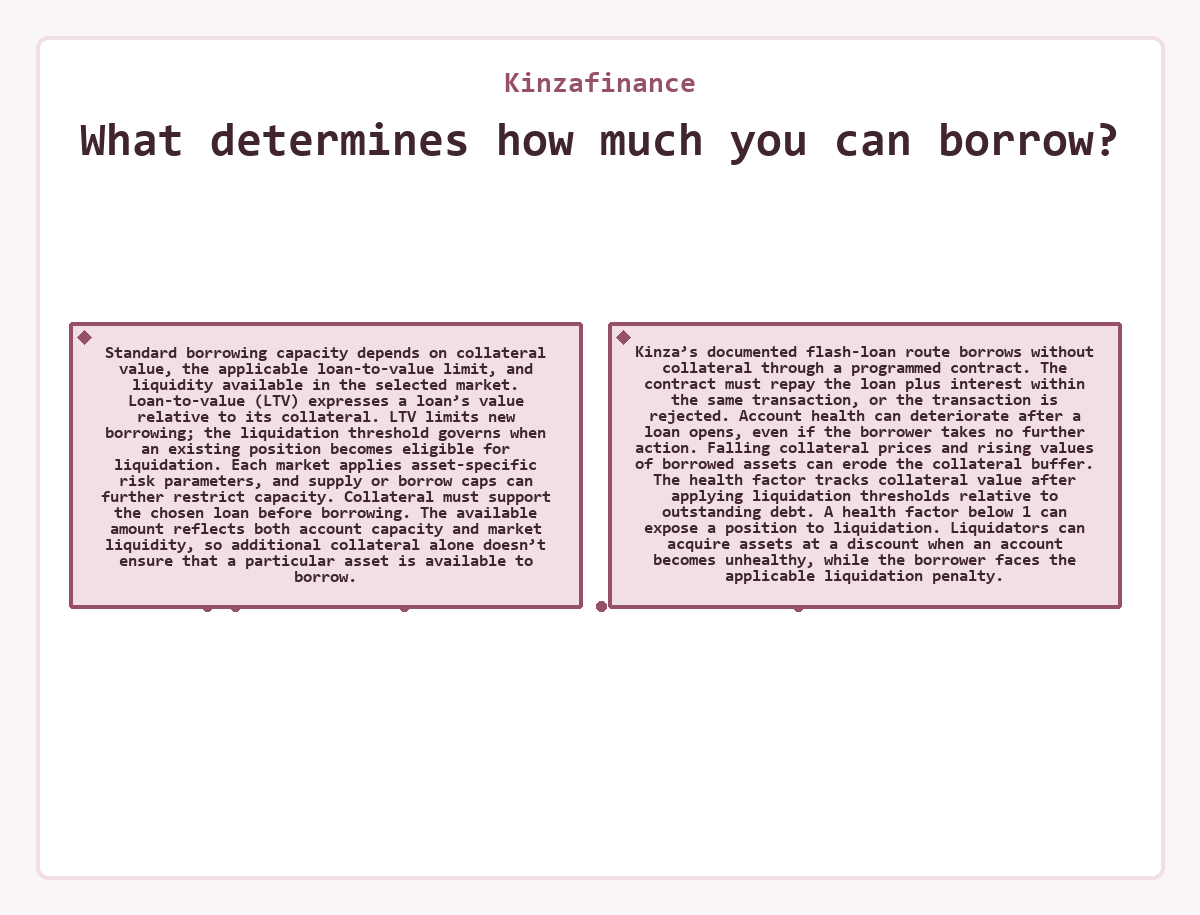
Standard borrowing capacity depends on collateral value, the applicable loan-to-value limit, and liquidity available in the selected market. Loan-to-value (LTV) expresses a loan’s value relative to its collateral. LTV limits new borrowing; the liquidation threshold governs when an existing position becomes eligible for liquidation. Each market applies asset-specific risk parameters, and supply or borrow caps can further restrict capacity. Collateral must support the chosen loan before borrowing. The available amount reflects both account capacity and market liquidity, so additional collateral alone doesn’t ensure that a particular asset is available to borrow. Kinza’s documented flash-loan route borrows without collateral through a programmed contract. The contract must repay the loan plus interest within the same transaction, or the transaction is rejected.
Account health can deteriorate after a loan opens, even if the borrower takes no further action. Falling collateral prices and rising values of borrowed assets can erode the collateral buffer. The health factor tracks collateral value after applying liquidation thresholds relative to outstanding debt. A health factor below 1 can expose a position to liquidation. Liquidators can acquire assets at a discount when an account becomes unhealthy, while the borrower faces the applicable liquidation penalty.
Bitcoin staking connects native BTC to kBTC
The Bitcoin staking product uses Babylon and issues kBTC so that staked BTC can participate in DeFi. Its design starts with native Bitcoin and delivers a liquid restaking token to a connected Ethereum Virtual Machine (EVM) wallet. The kBTC issuance basis is one token per BTC staked, minus applicable fees. That’s an issuance relationship, not a guaranteed secondary-market price. kBTC can support lending and borrowing within supported Kinza markets, connecting the staking product to the money market.
Staked BTC uses a multiparty computation (MPC) wallet jointly managed by Kinza, Cobo, and Coincover. This custody model differs from the lending protocol’s non-custodial design.
Current BTC redemption timing remains uncertain. The soft-launch terms restricted unstaking pending Babylon mainnet, while general product wording describes unstaking. Those statements don’t establish consistent current withdrawal terms. A transferable kBTC balance shouldn’t be treated as a promise of immediate native-BTC redemption.
Choosing lending income or Protected Collateral
A deposit’s collateral role doesn’t by itself determine whether other users can borrow it. Standard lending and Protected Collateral differ on that point. The choice affects whether the deposit earns borrower-paid interest while it supports the owner’s borrowing position.
- Choose standard lending when the deposit should supply borrowers and earn a share of their interest.
- Choose Protected Collateral when the deposit should remain unavailable to other borrowers, with no lending interest.
- Confirm that the supplied asset can serve as collateral for the intended borrowed asset.
- Use the applicable LTV and health factor to assess the proposed debt.
- For kBTC collateral, distinguish the loan’s repayment requirements from the separate BTC redemption terms.
Which networks does Kinza support?
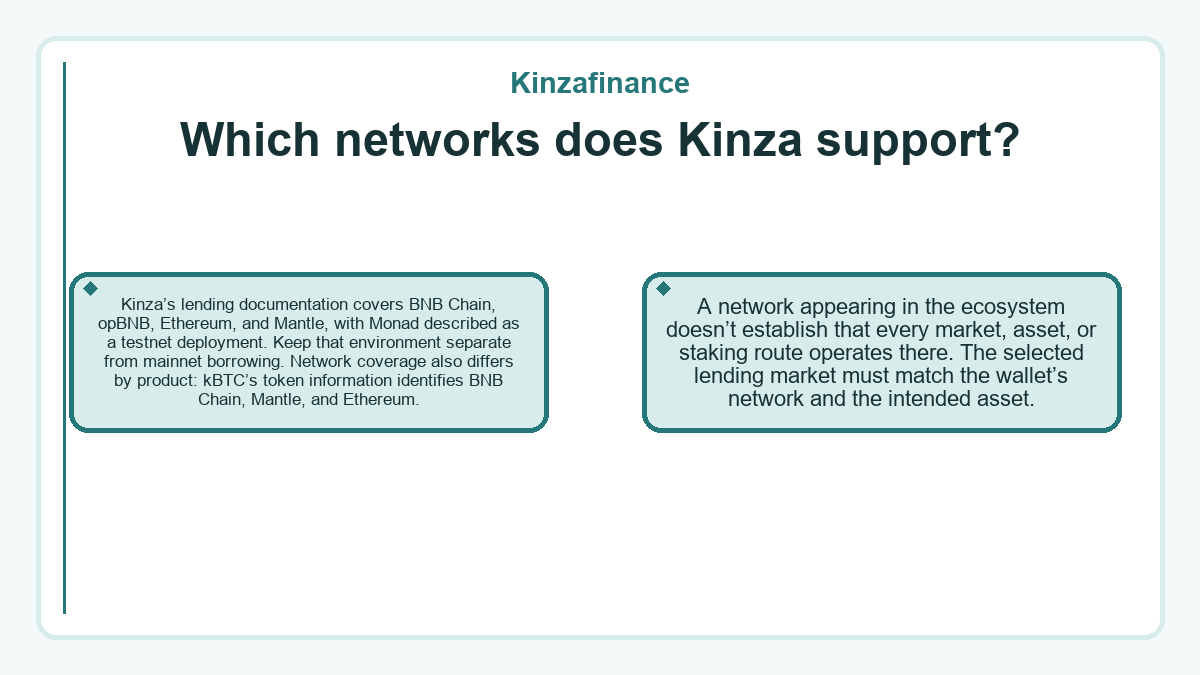
Kinza’s lending documentation covers BNB Chain, opBNB, Ethereum, and Mantle, with Monad described as a testnet deployment. Keep that environment separate from mainnet borrowing. Network coverage also differs by product: kBTC’s token information identifies BNB Chain, Mantle, and Ethereum. A network appearing in the ecosystem doesn’t establish that every market, asset, or staking route operates there. The selected lending market must match the wallet’s network and the intended asset.
Utilization changes rates, while transactions consume gas
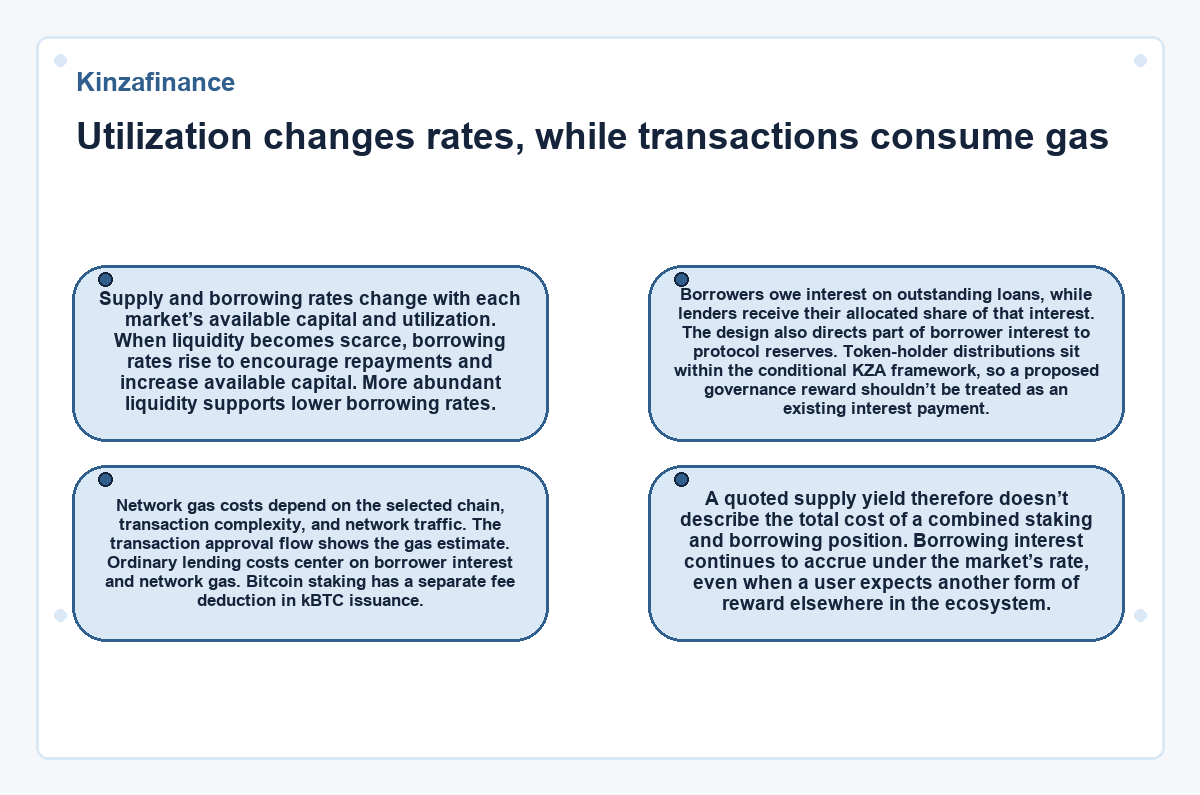
Supply and borrowing rates change with each market’s available capital and utilization. When liquidity becomes scarce, borrowing rates rise to encourage repayments and increase available capital. More abundant liquidity supports lower borrowing rates. Borrowers owe interest on outstanding loans, while lenders receive their allocated share of that interest. The design also directs part of borrower interest to protocol reserves. Token-holder distributions sit within the conditional KZA framework, so a proposed governance reward shouldn’t be treated as an existing interest payment.
Network gas costs depend on the selected chain, transaction complexity, and network traffic. The transaction approval flow shows the gas estimate.
Ordinary lending costs center on borrower interest and network gas. Bitcoin staking has a separate fee deduction in kBTC issuance. A quoted supply yield therefore doesn’t describe the total cost of a combined staking and borrowing position. Borrowing interest continues to accrue under the market’s rate, even when a user expects another form of reward elsewhere in the ecosystem.
Asset isolation and audits address different risks
Asset isolation limits exposure between riskier and more stable assets, while audits address weaknesses in reviewed code. Isolation doesn’t fix an asset’s price or remove a borrower’s liquidation risk. Security reviews concern defined contracts and versions, so they don’t establish protection for every future change or economic outcome. Kinza’s security measures include contract audits and a HackenProof bug bounty. Smart-contract exploits remain a relevant risk even when a project commissions audits.
Wallet owners control the private keys needed to manage their lending positions. A compromised wallet can expose the interest-bearing tokens that it holds. Keeping keys secure protects account access; it doesn’t prevent a change in collateral prices from triggering liquidation.
ModuLend would add curator-managed lending pools
ModuLend is the planned modular lending extension, where curators define which assets can collateralize particular borrowing relationships. The proposal also allows users to join pools that curators maintain. Those choices concern each pool’s asset relationships and risk configuration. Kinza also places a yield-bearing Layer 2 on its development roadmap; that proposal doesn’t establish an available lending network.
KZA governance and the 2025 points campaign
KZA’s ve-Real-Yield model links proposed token emissions to lending activity through vote-escrow governance and borrower-paid interest. The published design specifies KZA as a BEP-20 token on BNB Chain. Staking KZA would produce xKZA at a 1:1 ratio, with xKZA supplying voting power.
In that design, xKZA holders direct KZA emissions toward selected lending markets each weekly epoch. Borrowers in receiving markets would qualify for rewards under the applicable allocation rules. Voting participants would share borrower-interest revenue and could receive voting incentives, commonly called bribes. External parties would use those incentives to attract votes toward chosen markets.
These mechanics depend on the token generation event (TGE) and subsequent activation. The published launch terms don’t provide a confirmed TGE date.
Season 2’s announced points period fell in 2025, with deposit value and time shaping participation. Its design preserved Season 1 statistics while tracking the new season separately. Historical points record participation; they don’t establish a new earning window or a completed token distribution.
An individual’s eventual share follows programme rules and eligibility. The proposed airdrop allocation sets aside 5% of the stated 100 million KZA supply, equivalent to 5 million KZA.
What readers ask about Kinzafinance
Do I need KZA before supplying assets?
The documented lending entry path requires a compatible wallet and supported assets, without a KZA purchase prerequisite. Supplying and managing a position also incurs network gas costs. KZA has a separate role in the token governance design, whose staking and emission functions depend on TGE and activation.
Are kTokens transferable or tradable?
The lending design describes kTokens as transferable and tradable position tokens. Each kToken remains tied to its lending market’s supplied asset and interest accounting. Transferability doesn’t promise a buyer, sufficient trading liquidity, or a fixed secondary-market price.
How does Efficiency Mode change a borrowing position?
Efficiency Mode adjusts borrowing parameters when eligible related assets are used together. Its design raises eligible LTV limits, adjusts liquidation thresholds, and lowers liquidation penalties. Borrowing remains limited to E-mode assets, even though additional non-E-mode assets can serve as collateral. The same adjustments don’t apply automatically to every asset in an account.
Why doesn’t one airdrop point equal one KZA?
Airdrop points determine participation-based allocations; one point doesn’t entitle its holder to one KZA. Deposit value and time form the basis of the points model, while programme rules determine token allocation. A point balance therefore represents participation statistics rather than tokens already minted or delivered.
Which activity qualified for a referral bonus?
The referral programme tied bonuses to an invited user who linked a referral code and deposited assets. It specified a 10% bonus on that referred user’s airdrop points for both inviter and invitee. That percentage applied to points, not to deposited principal or a guaranteed KZA payment.
Does connecting a wallet conceal my account health?
Wallet-based access doesn’t hide account health from liquidation monitoring. Kinza’s lending design allows liquidators to inspect on-chain positions and identify unhealthy accounts. A wallet address and a person’s identity are different kinds of information, so permissionless access shouldn’t be interpreted as a promise of transaction anonymity.