 Kinzafinance
 dTokens, borrowing interest, and loan repayment
Kinzafinance tracks outstanding loans and their accruing interest through debt tokens called dTokens. Borrowing creates these tokens to represent debt in the borrowed asset; repayment burns them as the obligation decreases. Their balance can grow after the initial loan, even without another borrowing transaction. Reading the position means separating accrued interest from changes in collateral value and distinguishing asset approval from an executed repayment.
Updated ·
The short version: Asset approval permits repayment spending; only an executed repayment reduces the outstanding debt represented by dTokens.
The borrowed asset fixes what a dToken balance represents
A dToken balance belongs to a borrowing position in a particular asset and lending market. The borrowed token amount and the debt’s currency valuation can move for different reasons. Interest increases the debt recorded in the borrowed asset. A price movement changes that debt’s valuation without necessarily changing its token quantity. This matters when collateral and debt use different assets, because their prices can move independently. The token balance describes the obligation in its own units; collateral coverage also depends on relative asset values.
Loan to value (LTV) limits borrowing relative to collateral value. The health factor measures collateral coverage after accounting for liquidation thresholds.
Why can the debt grow without another loan?
Interest continues to accrue on outstanding debt at the rate of its specific lending market. Market utilization and available liquidity influence that rate, so borrowing costs can change while a loan remains open. Scarcer lending capital generally pushes borrowing rates upward; more available liquidity tends to reduce them. The original amount borrowed therefore doesn’t establish the later repayment amount. A rate shown when the loan began doesn’t fix the cost for every later period. The current debt balance incorporates accrued interest, while future interest depends on subsequent market conditions.
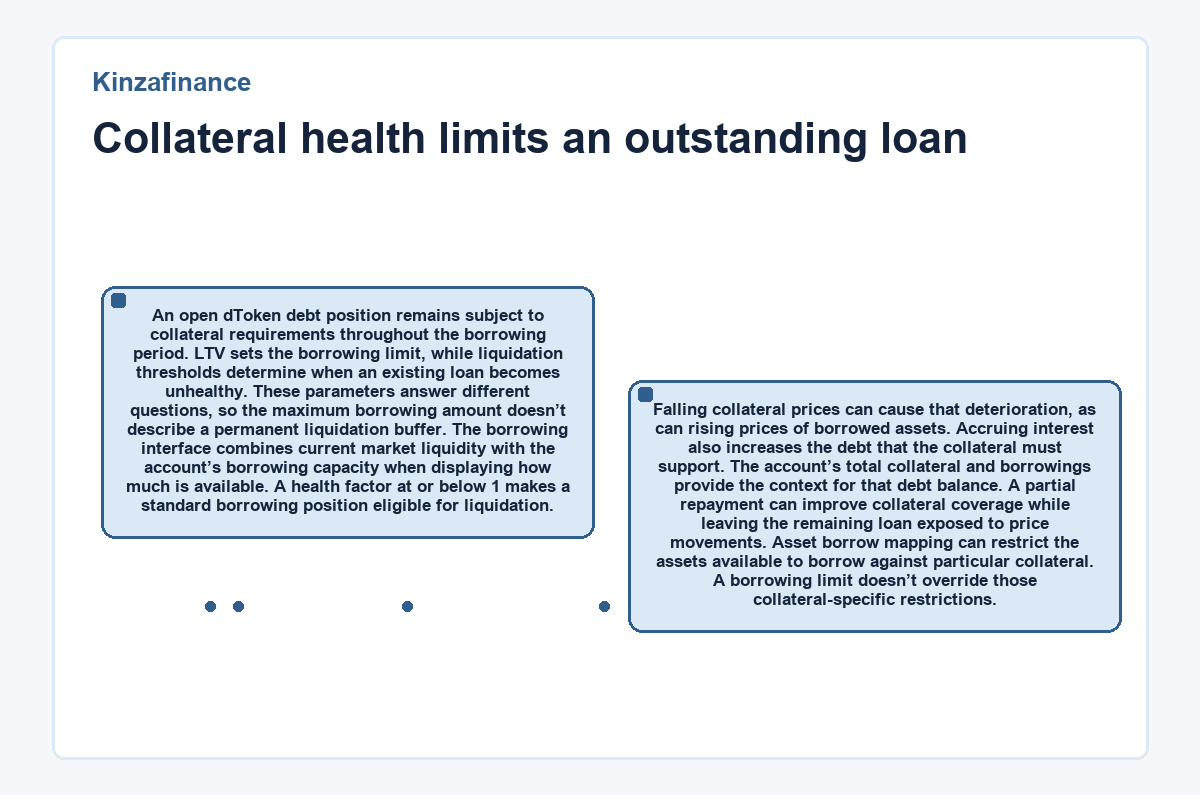
Collateral health limits an outstanding loan
An open dToken debt position remains subject to collateral requirements throughout the borrowing period. LTV sets the borrowing limit, while liquidation thresholds determine when an existing loan becomes unhealthy. These parameters answer different questions, so the maximum borrowing amount doesn’t describe a permanent liquidation buffer. The borrowing interface combines current market liquidity with the account’s borrowing capacity when displaying how much is available.
A health factor at or below 1 makes a standard borrowing position eligible for liquidation. Falling collateral prices can cause that deterioration, as can rising prices of borrowed assets. Accruing interest also increases the debt that the collateral must support. The account’s total collateral and borrowings provide the context for that debt balance. A partial repayment can improve collateral coverage while leaving the remaining loan exposed to price movements.
Asset borrow mapping can restrict the assets available to borrow against particular collateral. A borrowing limit doesn’t override those collateral-specific restrictions.
Approval, partial repayment, and full settlement
Permission to spend the repayment asset
Repayment transfers an asset from the borrower’s wallet, and the protocol requires approval before using that asset. Approval authorizes spending; it doesn’t settle the loan. The repayment must execute before it reduces the outstanding obligation.
The amount that the repayment settles
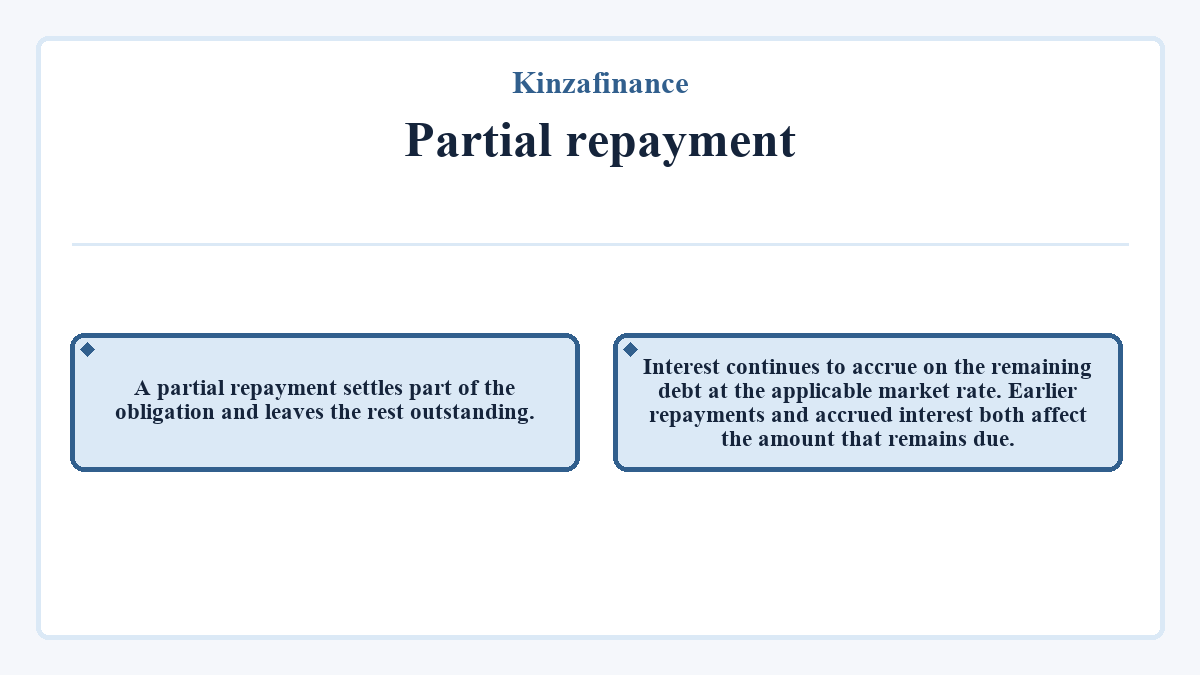
Partial repayment
A partial repayment settles part of the obligation and leaves the rest outstanding. Interest continues to accrue on the remaining debt at the applicable market rate. Earlier repayments and accrued interest both affect the amount that remains due.
Full repayment
The Max repayment option targets full settlement. Enough repayment assets must be available to cover interest that accrues while the transaction waits for execution. The protocol takes only the exact debt amount when repayment executes. A small additional balance accommodates that intervening interest; it isn’t a fixed extra protocol fee.
Full repayment clears the selected debt position. Debt in other borrowed assets remains outstanding until settled.
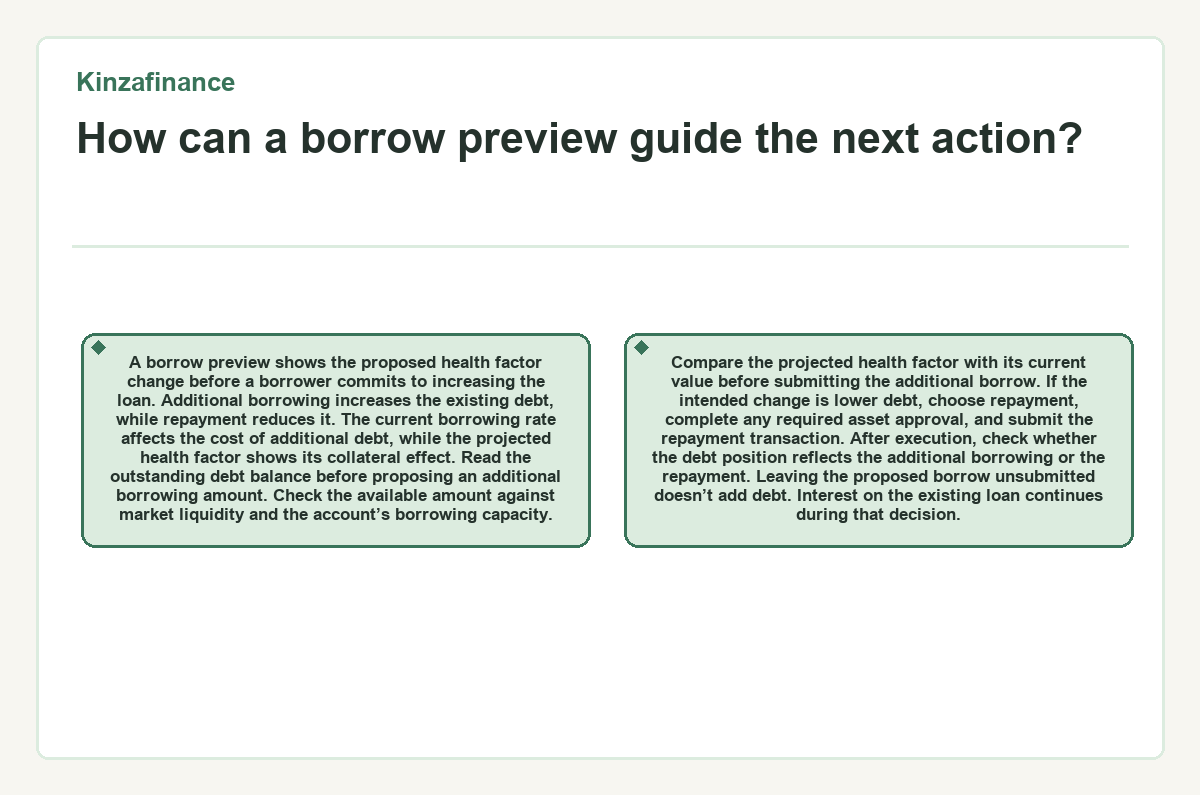
How can a borrow preview guide the next action?
A borrow preview shows the proposed health factor change before a borrower commits to increasing the loan. Additional borrowing increases the existing debt, while repayment reduces it. The current borrowing rate affects the cost of additional debt, while the projected health factor shows its collateral effect.
- Read the outstanding debt balance before proposing an additional borrowing amount.
- Check the available amount against market liquidity and the account’s borrowing capacity.
- Compare the projected health factor with its current value before submitting the additional borrow.
- If the intended change is lower debt, choose repayment, complete any required asset approval, and submit the repayment transaction.
- After execution, check whether the debt position reflects the additional borrowing or the repayment.
Leaving the proposed borrow unsubmitted doesn’t add debt. Interest on the existing loan continues during that decision.
dTokens and kTokens record different sides of lending
dTokens represent a borrower’s liability, while kTokens represent a supplier’s interest-bearing lending position. Supplier interest comes from borrower interest, and a supplied position can earn interest while a loan incurs borrowing costs. Whether those earnings offset borrowing costs depends on the supply balance, debt balance, and respective market rates.
Protected Collateral changes the supply-side treatment: those deposits remain unavailable to other borrowers and don’t earn lending interest. Eligible protected deposits can still secure a loan. The associated borrowing debt accrues interest under its market’s terms even though the protected deposit produces no lending interest.
Kinzafinance: reader questions
Does repaying a Kinzafinance loan require a network gas payment?
Repayment uses a blockchain transaction and incurs the selected network’s gas costs. These costs are separate from the borrowing interest reflected in dTokens. Gas varies with transaction complexity and network traffic, and the transaction approval prompt displays the expected gas charge. Standard lending doesn’t add a separate protocol usage fee.
Will full repayment automatically withdraw the collateral?
Full repayment settles the selected debt; withdrawing supplied assets is a separate action. A collateral withdrawal changes the account’s collateral coverage. If other loans remain in that lending account, the withdrawal must leave its final health factor above 1. Closing one debt therefore doesn’t establish that every supplied asset can leave the account.
What determines a liquidation penalty on a dToken loan?
The collateral asset’s risk parameters determine its liquidation penalty. The borrowing interface displays asset-specific penalty information, so one percentage doesn’t describe every loan. Efficiency Mode uses a separate configuration with lower liquidation penalties for its eligible positions. A penalty from another asset or configuration isn’t a reliable substitute.
Is a standard dToken loan subject to the flash-loan repayment rule?
Standard dToken borrowing maintains an ongoing collateralized debt position, so the same-transaction flash-loan rule doesn’t describe its repayment schedule. In the same-transaction flash-loan arrangement, a contract must return the borrowed funds and required interest before that transaction completes. Ordinary dToken debt accrues interest while collateral requirements continue to apply.
Why might a borrow cap block another loan despite sufficient collateral?
A borrow cap places an additional limit on how much of an asset can be borrowed. Collateral coverage alone therefore doesn’t establish that further borrowing is available. The cap serves a separate risk-control role from LTV, market liquidity, and the account’s health factor.