 Kinzafinance
 protected collateral supports borrowing without supplying assets to other borrowers
Kinzafinance protected collateral keeps supported deposits unavailable to other borrowers while allowing their use as loan collateral. That choice removes the lending interest that a supplier would receive from making those assets available to borrowers. The deposit can support personal borrowing when it qualifies as collateral and the account enables that use. Any resulting loan still carries its own interest and collateral requirements. Protection concerns access to the supplied assets; it doesn’t guarantee their value or prevent liquidation. The account’s borrowing capacity also depends on market liquidity and the risk settings for the collateral and debt assets.
Updated ·
Key takeaway: Keeping a deposit unavailable to other borrowers doesn’t remove the health-factor limits that govern a loan backed by that deposit.
A protected deposit can support personal borrowing
Once an eligible protected deposit counts as collateral, its assessed value helps determine how much the account can borrow. Kinzafinance uses overcollateralized loans, with asset-specific limits on borrowing relative to collateral value.
The collateral setting and the deposit’s lending treatment answer different questions. One determines whether the asset backs the account’s debt; the other determines whether borrowers can access the supplied balance.
Borrowing also requires liquidity in the asset that the account wants to borrow. A protected deposit can’t create a loan where the chosen lending market has no available funds.
The borrow preview shows the available amount and the projected change in health factor.
The account owes a loan only after it borrows, regardless of whether a collateral setting is already active.
The deposit mode controls borrower access
Default lending makes supplied assets available to borrowers and pays the supplier a portion of their interest. Protected collateral keeps supported deposits outside that lending use while preserving their potential role as collateral. Collateral eligibility remains an additional requirement for a loan.
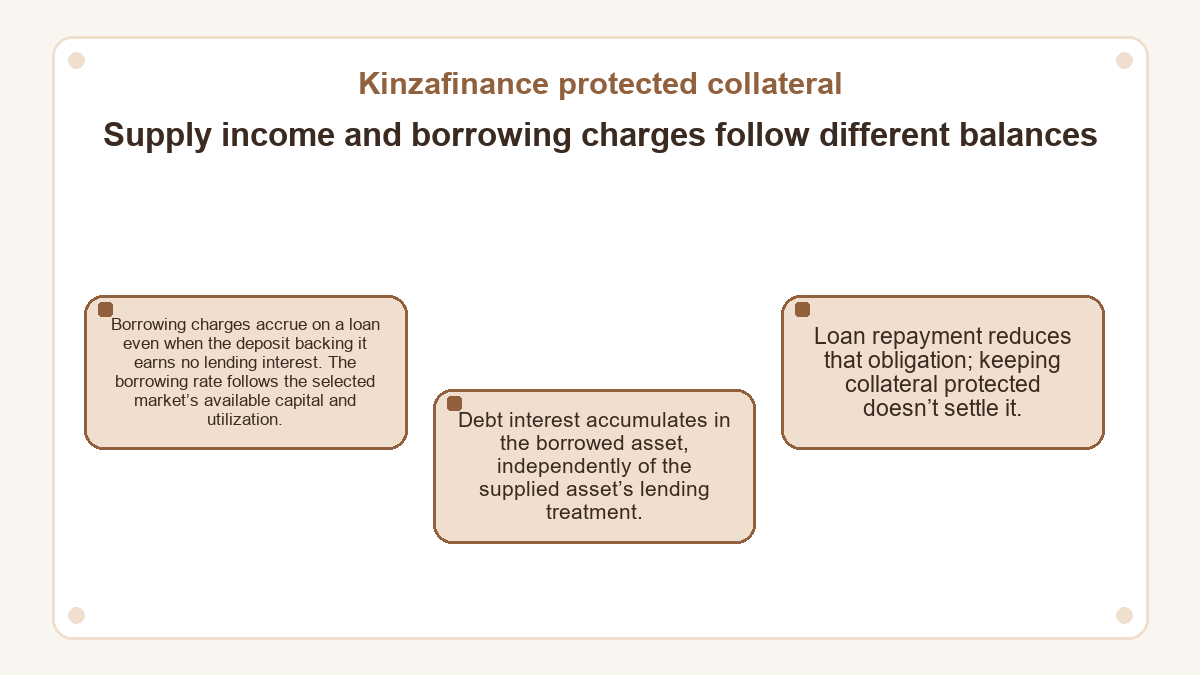
Supply income and borrowing charges follow different balances
Borrowing charges accrue on a loan even when the deposit backing it earns no lending interest. The borrowing rate follows the selected market’s available capital and utilization. Debt interest accumulates in the borrowed asset, independently of the supplied asset’s lending treatment. Loan repayment reduces that obligation; keeping collateral protected doesn’t settle it.
Can protected collateral still be liquidated?
Yes, an account that borrows against protected collateral remains subject to liquidation when its health factor reaches 1 or below. That measure compares collateral values, weighted by their liquidation thresholds, with the total value of outstanding borrowing. The protected setting doesn’t remove collateral from that calculation when it backs a loan.
A fall in collateral value can reduce account health, as can an increase in the value of borrowed assets. Accruing debt interest also increases the obligation that collateral must cover.
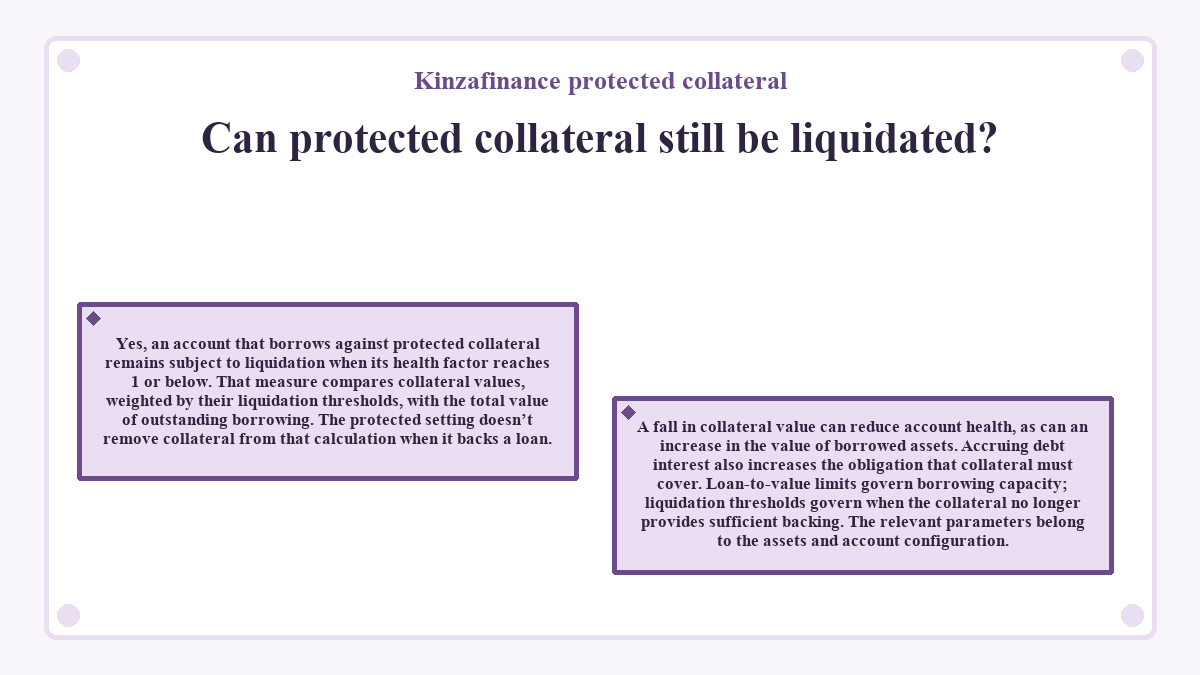
Loan-to-value limits govern borrowing capacity; liquidation thresholds govern when the collateral no longer provides sufficient backing. The relevant parameters belong to the assets and account configuration.
Asset isolation and borrow mapping impose separate restrictions
Asset isolation governs collateral combinations, while borrow mapping restricts which borrowed assets can accompany particular collateral. Neither term describes whether another borrower can access a protected deposit.
An asset with an Isolated collateral type can’t serve alongside other collateral in the same account. The documented isolation rules also limit borrowing to USDT or USDC and impose a debt limit. An account using isolated collateral can still supply other assets as liquidity, without using them as additional collateral.
Borrow mapping can block enabling collateral when the account already holds incompatible debt. It can also block an incompatible new loan when that collateral is active.
Reading a protected balance before taking a loan
A protected deposit can remain unchanged while the account shows borrowing capacity, because its collateral role doesn’t require lending-interest accrual. The conditions behind those figures determine what the account can do:
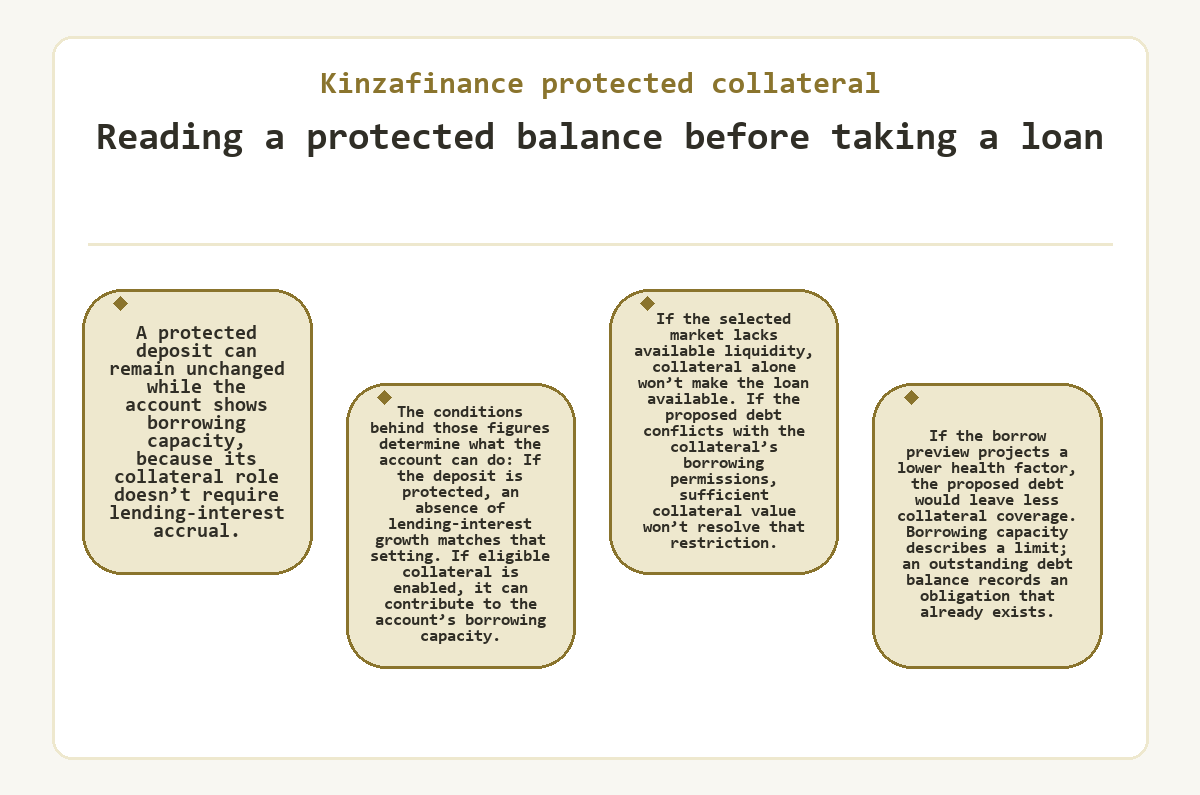
- If the deposit is protected, an absence of lending-interest growth matches that setting.
- If eligible collateral is enabled, it can contribute to the account’s borrowing capacity.
- If the selected market lacks available liquidity, collateral alone won’t make the loan available.
- If the proposed debt conflicts with the collateral’s borrowing permissions, sufficient collateral value won’t resolve that restriction.
- If the borrow preview projects a lower health factor, the proposed debt would leave less collateral coverage.
Borrowing capacity describes a limit; an outstanding debt balance records an obligation that already exists.
Withdrawals depend on the collateral that remains
With an outstanding loan, a collateral withdrawal must leave the account’s health factor above 1. The withdrawal preview shows how removing the selected amount would change that measure.
Reducing collateral can shrink the backing for debt that remains, even though other borrowers haven’t had access to the deposit. The withdrawal constraint follows the outstanding loan, including interest, and the collateral supporting it. A protected setting doesn’t promise that the full deposited amount remains withdrawable throughout an active loan.
Kinzafinance protected collateral FAQ
How much gas does a protected-collateral transaction cost?
The gas cost varies with the network, transaction complexity, and network traffic. Protection doesn’t remove the gas requirement for on-chain transactions. The transaction prompt shows the estimated network charge. That cost is separate from supply interest and any interest due on borrowing.
Does protected collateral hide an account’s health factor?
No, account health remains visible within Kinzafinance’s transparent lending system. Keeping a deposit unavailable to borrowers concerns asset use. It doesn’t conceal the account-health information that liquidators can monitor.
What determines a liquidation penalty when protected collateral backs a loan?
The applicable asset and mode determine a loan’s liquidation penalty. Kinzafinance displays asset-specific penalty information during asset selection for borrowing. Where Efficiency Mode applies, its separate penalty configuration also matters. Protection doesn’t establish a fixed penalty rate for a loan.
Which token records debt backed by a protected deposit?
Kinzafinance records lending-market debt with dTokens. Their balance follows the borrowed asset and its interest rate, while repayment burns the corresponding debt tokens. This record concerns the loan obligation; it doesn’t represent lending income on the protected deposit.
Is a Closed collateral type eligible to back a protected-collateral loan?
An asset with a Closed collateral type can’t serve as loan collateral. Its classification allows a lending deposit to earn interest while excluding it from borrowing support. Using the protected feature for borrowing requires an asset that qualifies as collateral.